Blog ·
What is a lunar mass driver?
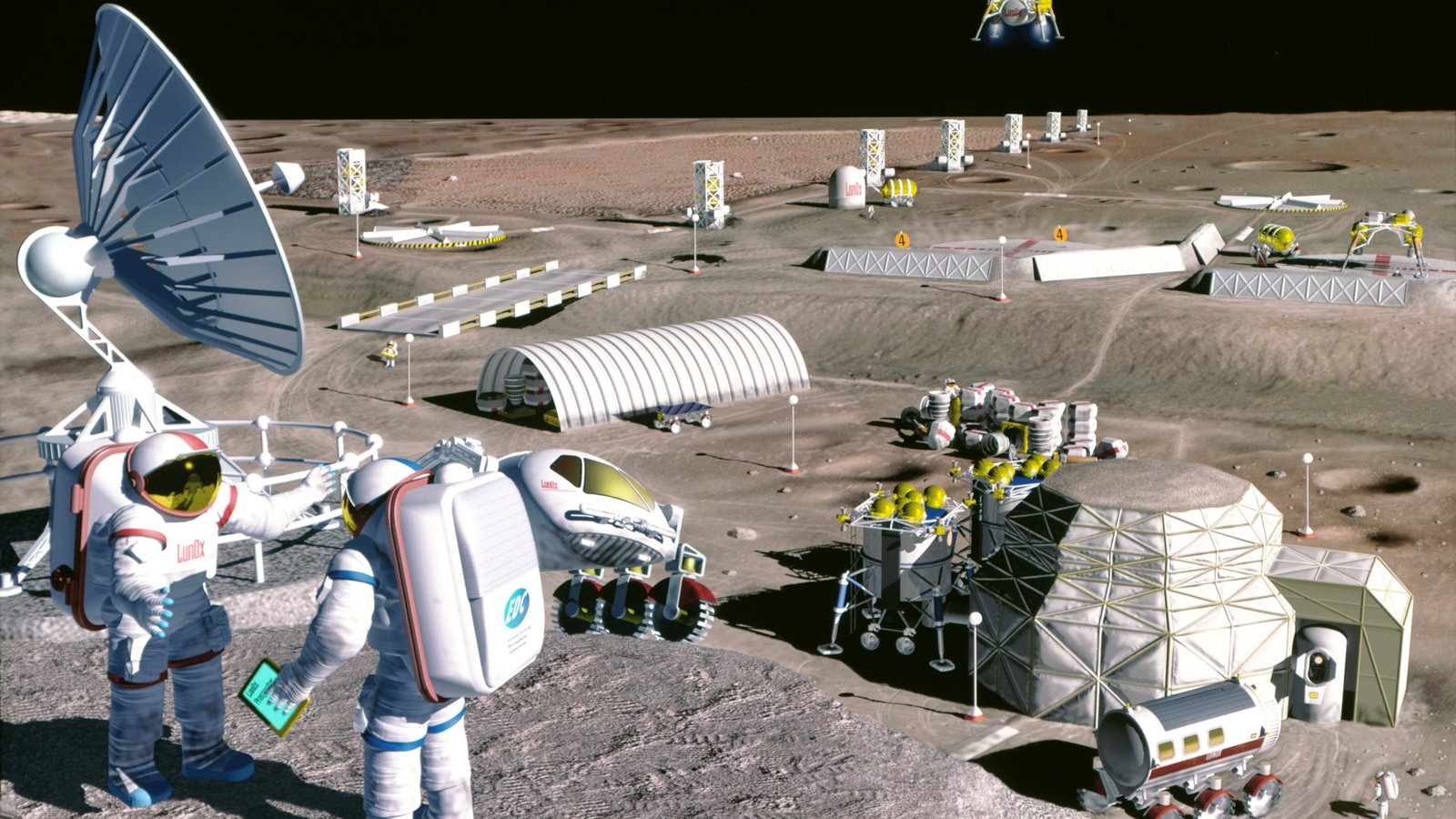

A lunar mass driver is a long electric track on the Moon that would launch cargo into space using magnets instead of rockets. A row of coils pushes a small carrier, often called a bucket, faster and faster along the track until it releases its load at the end, fast enough to reach lunar orbit or leave the Moon altogether. The idea dates from the 1970s, a small model was built and run in 1977, and Elon Musk revived it in February 2026. No full-size mass driver has ever been built, on the Moon or anywhere else. Our page on the lunar mass driver follows the story with its sources and video moments.
How does a mass driver work?
It is an electromagnetic launcher. In the design NASA studied in the 1970s, set out in an appendix to its 1977 report Space Settlements: A Design Study (NASA SP-413), a magnetically levitated bucket is driven by a linear motor along 10 kilometers of track, accelerating at 288 meters per second squared, roughly 29 times Earth's gravity. Each bucket carries under 10 kg, and the design speed at the end of the track is 2,400 meters per second. Only the cargo flies: it leaves the bucket at the end of the track.
Because nothing burns, the only thing used up is electricity. Henry Kolm, the MIT engineer who co-designed the first model, described the machine in an L5 News article in September 1980 as "a line of pulse coils surrounding a barrel of aluminum guide rails."
Why put one on the Moon and not on Earth?
Because leaving the Moon takes far less speed, and there is almost no air in the way. NASA's Moon fact sheet gives these figures:
| Moon | Earth | |
|---|---|---|
| Surface gravity | 1.62 m/s² | 9.80 m/s² |
| Escape velocity | 2.38 km/s | 11.2 km/s |
The energy needed to reach a speed grows with the square of that speed, so by our arithmetic from those two escape velocities, throwing a kilogram off the Moon takes about one twenty-second of the energy needed to throw it off Earth. On Earth, a payload leaving a track at that speed would also have to punch through the thick lower atmosphere; on the Moon there is no such barrier, so the track can lie on the ground and fire straight out.
What was the mass driver supposed to launch?
Raw lunar rock, in bulk. The physicist Gerard K. O'Neill wanted to build large space colonies from material that did not have to be lifted out of Earth's deep gravity well. The Space Studies Institute, which O'Neill founded in 1977, says the payloads would be accelerated "to the escape velocity of the Moon" and "collected at a point in space to serve as the material source for space manufacturing."
NASA's 1975 summer study worked the plan through in detail. Its baseline system was meant to move 10 million tonnes of lunar material to L5 over 10 years, L5 being one of the stable balance points of the Earth and Moon. The cargo would be caught first near another of those points, L2, where the study proposed five large "mass catchers", each slowing incoming material from 200 meters per second to 20.
Has a mass driver ever been built?
Only small test models. The Space Studies Institute says O'Neill and Kolm, with graduate students at MIT, built Mass Driver 1 in 1977 from about $3,000 worth of scrounged electronic parts, and that "in its initial tests, this push-only machine achieved over 33 gravities." Kolm wrote that it was built in four months and shown at a space manufacturing symposium in Princeton in May 1977. O'Neill's own newsletter of June 12, 1977 describes a two-meter model that produced "more than thirty gravities of acceleration."
Later models went much harder. The institute reports that Mass Driver II ran at "nearly 500 gravities" and Mass Driver III at "over 1,800 gravities." None of them launched anything into space: they were laboratory tracks that proved the coils could do the pushing.
A note on the numbers: accounts of Mass Driver 1 differ on small details. The institute gives "over 33 gravities" and the 1977 newsletter "more than thirty," and other summaries give other costs and dates. We have used the institute's and Kolm's own accounts and say where each figure comes from.
What did Elon Musk propose in 2026?
A mass driver that would launch satellites, not rock. In February 2026, after SpaceX took over his AI company xAI, Elon Musk described a factory on the Moon that would build AI satellites and fling them into deep space. Jeff Foust of The Space Review quotes him: "By using an electromagnetic mass driver and lunar manufacturing, it is possible to put 500 to 1000 TW/year of AI satellites into deep space," and, at a company meeting, "We're actually going to have a mass driver on the Moon."
Foust also notes what was missing: "In none of the filings, memos, or presentations did Musk provide a schedule for his AI-enabled space ambitions." The same article reports the engineer Robert Zubrin's skepticism that computing in space could compete with data centers on Earth.
Would a modern mass driver look like O'Neill's?
Not necessarily. In May 2026 Casey Handmer worked through, on his blog, how to build a lunar mass driver with today's assumptions, and his answer is quite different from NASA's 1970s design:
- Aim lower. Instead of escape velocity, he launches at 1.6 km/s, enough to reach low lunar orbit, and has the rock collected there.
- Push harder. At 1,000 times Earth's gravity, his launch track "need only be 128 m long," against the 10 km of the 1977 design.
- Power. For 10 million tonnes of rock a year, he estimates about 450 MW of power, assuming the driver is 90% efficient.
Handmer is also frank about its limits, writing that a lunar mass driver "is unlikely to drastically improve the economics of space-based AI." These are one engineer's estimates on his own blog, not a design anyone is building.
So is a lunar mass driver real?
The physics is real, and small versions have run in laboratories since 1977. A working launcher on the Moon is not: it would need a base, a power plant and a steady supply of cargo first, and as our pages on the NASA Moon Base and the International Lunar Research Station show, no permanent base exists yet. As of November 2026, Musk's mass driver is an announced idea with no published design, schedule or hardware.
The short answer
A lunar mass driver is a magnetic launch track that would throw cargo off the Moon using electricity alone. It suits the Moon because the Moon's escape velocity is about a fifth of Earth's and it has almost no air. O'Neill's team proved the principle with a small model in 1977, NASA studied a 10 km version to supply space colonies, and in 2026 Elon Musk proposed one to launch AI satellites. None has been built at full size.
More from the blog
 Why did World War I end on Nov 11?The armistice was signed around 5 a.m. on Nov 11, 1918, and took effect at 11 a.m. Why that day, why that hour, what the six-hour gap cost, and how the date became Veterans Day and Remembrance Day.
 When will the Tesla Roadster come out?Tesla says production of the new Roadster will begin in 2028. It first promised the car for 2020, and every date since has slipped. Here is the record, and what you can and cannot buy today.
 Why was Farscape canceled?Sci Fi said falling ratings and a steep rise in cost. The show's creator called it a business decision made while its studio was in turmoil. What each side said, and how the story got its ending anyway.