Blog ·
Why did World War I end on Nov 11?
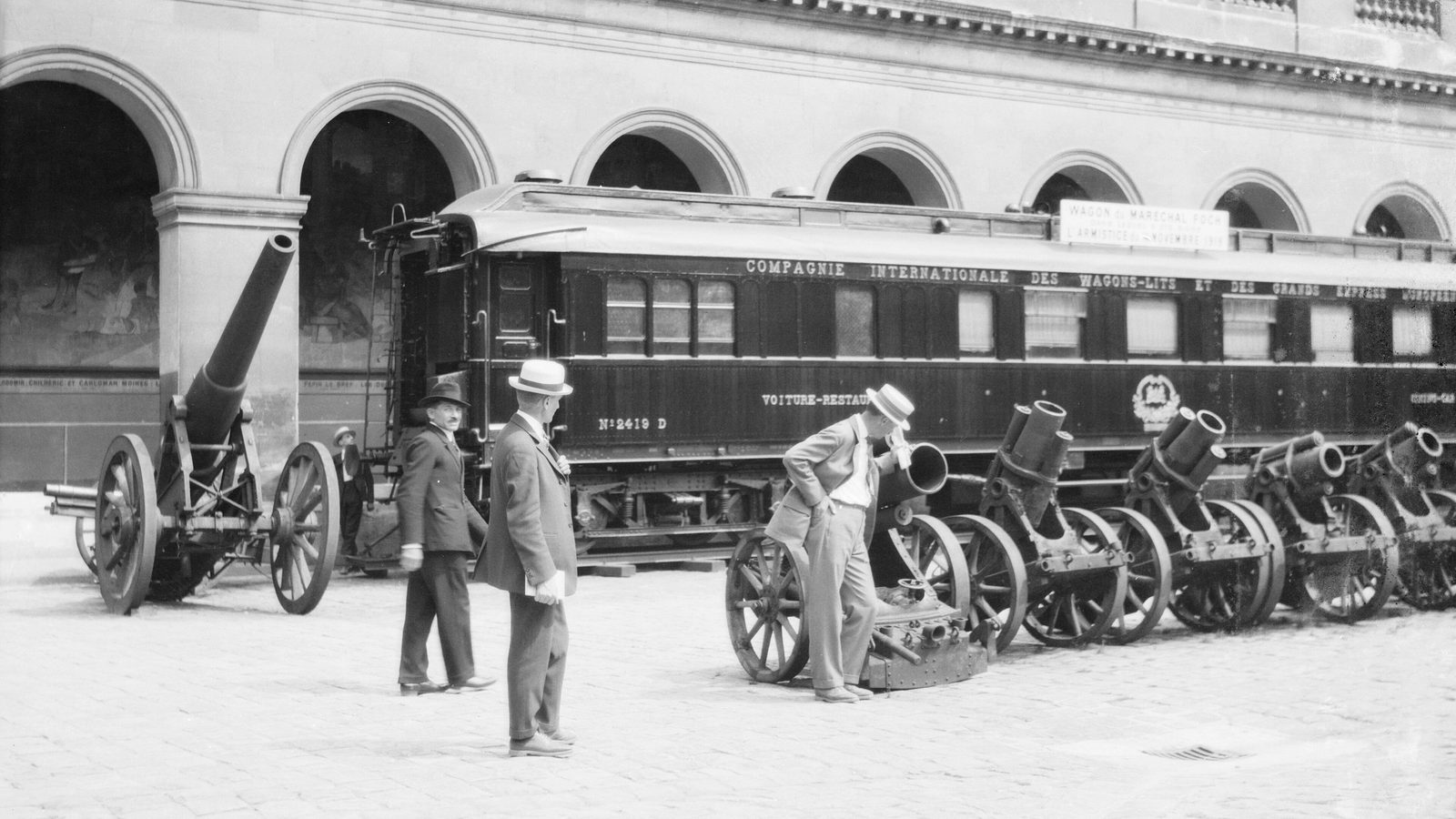

World War I stopped on Nov 11, 1918, because that was the morning Germany signed the armistice the Allies had put in front of it three days earlier. The signatures went on around 5 a.m. in a railway carriage in the Forest of Compiègne, and the fighting was set to stop six hours later, at 11 a.m. French time. That is where "the eleventh hour of the eleventh day of the eleventh month" comes from. Why it was 11 o'clock, and not the moment of signing, has two explanations, and the six hours in between cost thousands of lives. Our page on World War I covers the whole war.
Why did the war end in November 1918?
Because Germany could no longer fight on. By the autumn of 1918 its allies were dropping out one by one: the Ottomans sought terms on Oct 30 and Austria-Hungary reached an armistice on Nov 4, and on Nov 9 Kaiser Wilhelm II abdicated, as our World War I page sets out with its sources.
The armistice itself was a set of terms rather than a negotiation. The National WWI Museum and Memorial explains that the Allied delegation, led by the Supreme Allied Commander, Marshal Ferdinand Foch, "left no room for negotiation," and that the German delegation "was given 72 hours to accept the terms," which were made severe on purpose so that Germany could not resume fighting.
Why at 11 a.m., and not when it was signed?
The museum records the order Foch sent to Allied commanders once the agreement was made at 5 a.m.: "Hostilities will be stopped on the entire front beginning at 11 o'clock, November 11th (French hour)." Why that hour was chosen gets two different answers.
- The deadline ran out then. The historian Joseph Persico, author of a book on the last day of the war, told PBS NewsHour on Nov 11, 2004 that it was "a rather curious mechanical explanation": Foch had given the Germans 72 hours, and that deadline fell at the eleventh hour of the eleventh day of the eleventh month.
- A British admiral proposed it. The historian Robert Beaken, in a chapter published by Cambridge University Press, writes that the British prime minister, David Lloyd George, had told the British representative, Admiral Sir Rosslyn Wemyss, to arrange for the armistice to begin at 2:30 p.m. so that he could announce it in the House of Commons. Wemyss "exceeded his orders." He thought more lives might be lost if the war ran even a few hours longer than it had to, and he liked the poetry of the eleventh hour. The French and the Germans agreed to his suggestion of 11 a.m., and the armistice was signed at 5:10. Beaken adds that Wemyss paid for it: he was not given the £100,000 grant other service chiefs received, and he was made a baron, not an earl like the others.
The two accounts do not have to contradict each other, since a deadline that happened to fall at 11 would have made Wemyss's choice an easy one to accept. But they give different reasons, and we have not found the original record that would settle which weighed more.
How many soldiers died on the last morning?
Many, because the fighting went on until the last minute. Persico's estimate, in the same PBS interview, is that "some 10,900 men on this last day are killed, wounded or missing, slightly more even than D-Day," the Allied landings in Normandy during World War II. That is one historian's count of all the casualties of the whole day, not an official total, and we know of no official figure to set beside it.
Some of the last deaths came only a minute or two before 11 o'clock:
| About 5 a.m. | The armistice is signed in Foch's railway carriage in the Forest of Compiègne |
| 10:58 a.m. | Private George Lawrence Price is killed near Mons, in Belgium; Veterans Affairs Canada says he is believed to be the last Canadian soldier to die in battle in the war |
| 10:59 a.m. | Henry Gunther, an American soldier from Baltimore, is killed "less than one minute before the end of the Great War," Time reported in 2018 |
| 11 a.m. | The guns stop along the Western Front |
The signing time is not agreed to the minute: the National WWI Museum gives 5 a.m., while Beaken gives 5:10.
Was the armistice the official end of the war?
No. An armistice only stops the fighting. As the US Department of Veterans Affairs puts it, the war "officially ended when the Treaty of Versailles was signed on June 28, 1919," seven months after the guns fell silent.
How did Nov 11 become Veterans Day and Remembrance Day?
The anniversary was marked from the first year. The Veterans Affairs history of Veterans Day gives the American steps:
- November 1919: President Woodrow Wilson proclaimed Nov 11 as the first commemoration of Armistice Day.
- May 13, 1938: an act of Congress made Nov 11 a legal holiday, "Armistice Day," dedicated to the cause of world peace.
- June 1, 1954: after World War II and Korea, Congress replaced the word "Armistice" with "Veterans," and the day came to honor American veterans of all wars.
- 1968 to 1978: the Uniform Holiday Bill moved Veterans Day to a Monday, and a law President Gerald R. Ford signed on Sep 20, 1975, returned it to Nov 11 from 1978.
In Britain, the hour mattered as much as the day. According to The Open University, King George V announced a two-minute silence on Nov 7, 1919, and it was first kept at 11 o'clock on Nov 11, 1919, a year after the armistice. That silence at 11 a.m. is still the center of Remembrance Day there.
The short answer
The war ended on Nov 11 because that was when Germany, beaten and with its emperor gone, signed the Allies' terms, and it ended at 11 a.m. because that was the hour written into the agreement, whether chosen for the deadline, for the symmetry, or both. The six hours between the signature and the ceasefire are the most painful part of the story, and the reason so many countries still stop at 11 o'clock to remember.
More from the blog
 When will the Tesla Roadster come out?Tesla says production of the new Roadster will begin in 2028. It first promised the car for 2020, and every date since has slipped. Here is the record, and what you can and cannot buy today.
 Why was Farscape canceled?Sci Fi said falling ratings and a steep rise in cost. The show's creator called it a business decision made while its studio was in turmoil. What each side said, and how the story got its ending anyway.
 How did Patrick Stewart die?Sir Patrick Stewart died at home in Los Angeles on Wednesday, Oct 28, 2026, aged 86, after Alzheimer's disease and Lewy body dementia. What those conditions are, his life in brief, and the tributes.