Blog ·
How long did it take Apollo 11 to get to the Moon?
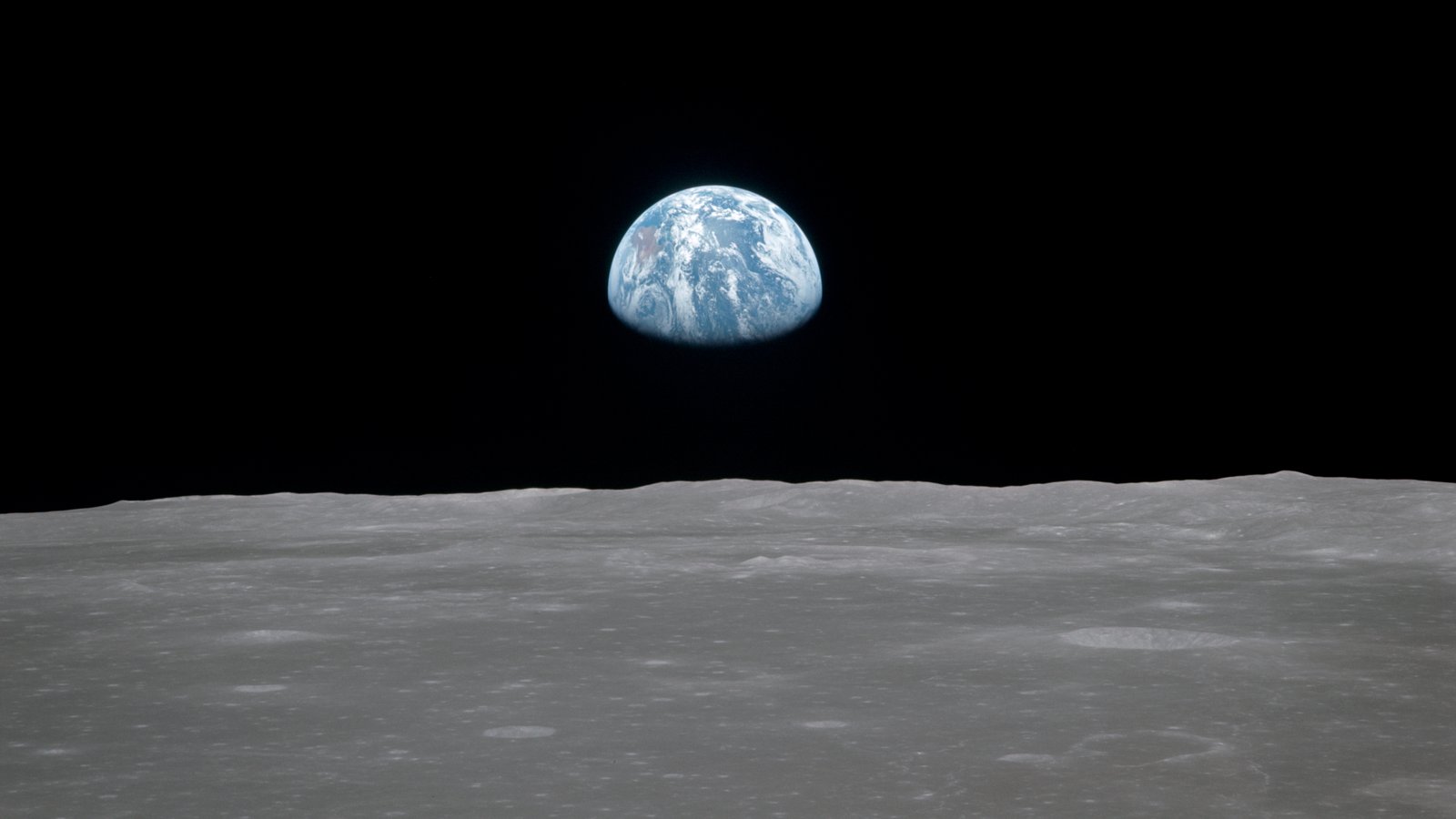

Apollo 11 took about 75 hours and 50 minutes, a little over three days, to get from launch to lunar orbit. It launched on Jul 16, 1969, entered orbit around the Moon on Jul 19, and landed on Jul 20, about 102 hours and 45 minutes after leaving Florida: four days, six and three quarter hours. The trip home was shorter, about 60 hours from leaving lunar orbit to splashdown, and the whole mission lasted 8 days, 3 hours, 18 minutes and 35 seconds. Our page on Apollo 11 tells the whole story of the mission, with its sources and video moments from NASA.
What was the Apollo 11 timeline, step by step?
The times below are from NASA's own records: the Space Science Data Coordinated Archive entry for the command module gives the clock times in Universal Time (UT), and NASA's Apollo 11 mission overview gives the time since launch. The two agree.
| Event | Date and time (UT) | Time since launch |
|---|---|---|
| Launch from Kennedy Space Center | Jul 16, 1969, 13:32 | 0 |
| Third stage fires to send the crew to the Moon | Jul 16, 16:16 | 2 hours, 44 minutes |
| Engine burn puts Apollo 11 into lunar orbit | Jul 19, 17:21:50 | about 75 hours, 50 minutes |
| Eagle lands on the Moon | Jul 20, 20:17:40 | about 102 hours, 45 minutes |
| Eagle lifts off from the Moon | Jul 21, 17:54:01 | about 124 hours, 22 minutes |
| Engine burn starts the trip home | Jul 22, 04:54:42 | about 135 hours, 23 minutes |
| Splashdown in the Pacific | Jul 24, 16:50:35 | 195 hours, 18 minutes, 35 seconds |
In local time at the launch site, Apollo 11 lifted off at 9:32 a.m. EDT and Eagle touched down at 4:17 p.m. EDT on Jul 20, as the same NASA archive records.
So was it three days or four?
Both answers are right, because they measure different things.
- Three days is the trip itself. The spacecraft spent its first two hours and 44 minutes in orbit around Earth, then the third stage of the Saturn V fired for 5 minutes and 48 seconds and sent it toward the Moon. From that burn to lunar orbit took about 73 hours, just over three days.
- Four days is the time to the landing. After reaching the Moon, the crew orbited it for about a day before Neil Armstrong and Buzz Aldrin took the lunar module Eagle down to the Sea of Tranquility, while Michael Collins stayed in orbit aboard Columbia.
Some popular accounts round the outbound trip to "three days" and others to "four," and this is usually why.
How far did Apollo 11 have to travel?
NASA puts the Moon's average distance at 238,855 miles (384,400 kilometers). Apollo 11 did not fly a straight line, though. It left from Earth orbit and had to arrive at a moving target, so the real path was longer than that figure. NASA's mission overview lists a distance of 953,054 miles for the flight, but the page does not say exactly what that number measures, so we would not lean on it.
The mission report NASA published in 1969 says the burn that left Earth orbit raised the spacecraft's speed to "roughly 24,200 mph."
Why was the trip home faster?
Leaving lunar orbit on Jul 22 to splashdown on Jul 24 took just under 60 hours, about 13 hours less than the trip out. The way out also included a long burn to slow down: to be captured by the Moon, the service module's main engine fired against the direction of travel for 357.5 seconds. Coming home, the capsule did not need to stop. It hit the atmosphere and splashed down in the Pacific, about 825 nautical miles southwest of Hawaii by the 1969 report's figure.
How does Apollo 11 compare with other trips to the Moon?
Time to the Moon depends on what a mission needs to do when it gets there. A probe that only flies past can be much faster than a crew that has to stop and land.
| Mission | Launched | Reached the Moon | Roughly how long |
|---|---|---|---|
| Apollo 11 (crew, landed) | Jul 16, 1969 | Lunar orbit Jul 19 | about 3 days, 4 hours |
| New Horizons (probe to Pluto, did not stop) | Jan 19, 2006 | Passed the Moon the same day | about 9 hours |
| Artemis I (uncrewed Orion) | Nov 16, 2022 | Closest approach Nov 21 | about 5 days |
| Artemis II (crew, flyby) | Apr 1, 2026 | Flyby Apr 6 | about 5 days |
A few notes on that table:
- New Horizons was not aiming for the Moon at all. NASA's caption for an image of the launch, published on Jan 24, 2006, noted that it passed the Moon only nine hours after launch, on its way to Pluto, which it still did not reach until 2015.
- The Artemis missions are not like-for-like with Apollo 11. They did not land, and the dates above are days on the calendar, since we did not find launch and flyby times on the same NASA pages. Treat "about 5 days" as a rough figure. Artemis II, which carried a crew around the Moon without landing, lasted 9 days, 1 hour and 32 minutes and splashed down on Apr 10, 2026.
Do the sources ever disagree?
On the main times, no. The archive's clock times and the overview's hours since launch line up to the minute. There are two small wrinkles worth knowing:
- NASA's mission overview says the burn to come home "began July 21", while the archive gives Jul 22 at 04:54:42 UT, and the 1969 report says "12:56 A.M., July 22" in Eastern time. The date depends on the clock: in Houston, home of Mission Control, that moment fell just before midnight on Jul 21, which may be where the overview's date comes from. We use the archive's UT time.
- The 1969 report times reentry at 12:35 p.m. and splashdown "13 minutes later," which comes out a couple of minutes earlier than the 12:50:35 p.m. EDT in NASA's archive. The archive's more precise figure is the one used above.
If you want to go further, our pages on NASA Moon Base and the International Lunar Research Station cover the plans to send people back to the Moon to stay, and how far along they are.
More from the blog
 Did Einstein fail math?No. Albert Einstein's school records show top marks in mathematics. What he did fail was a university entrance exam at 16, on the non-science part. Here is what the records say and where the myth came from.
 What is a lunar mass driver?A lunar mass driver is a proposed electric track on the Moon that would throw cargo into space with magnets instead of rockets. How it would work, why the Moon suits it, what was built in 1977, and where Elon Musk's 2026 plan stands.
 Why did World War I end on Nov 11?The armistice was signed around 5 a.m. on Nov 11, 1918, and took effect at 11 a.m. Why that day, why that hour, what the six-hour gap cost, and how the date became Veterans Day and Remembrance Day.