Blog ·
Is Wikipedia a reliable source?
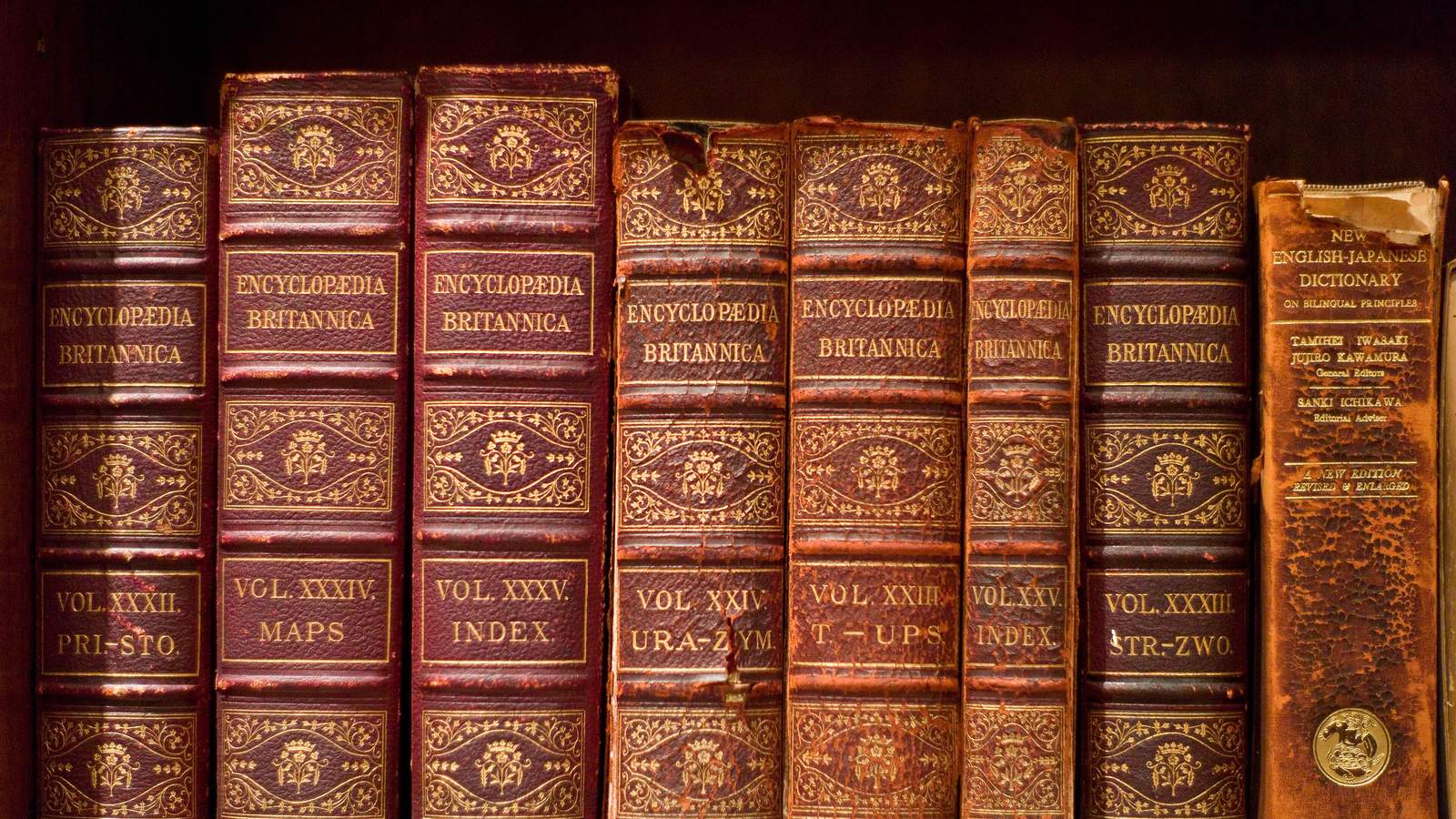

Wikipedia is usually accurate enough to learn from, but it is not a source you should cite, and Wikipedia says so itself. Its own guidance warns that an article "can be edited by anyone at any time," so what you read at a given moment may be vandalism, unfinished or simply wrong. The best way to use it is as a map: read the article to get your bearings, then follow its footnotes to the sources underneath and rely on those. Our page on Wikipedia tells the story of the site itself, from its launch in 2001 to its struggles with artificial intelligence.
The image above shows volumes of the ninth edition of the Encyclopaedia Britannica, the kind of reference work Wikipedia has been measured against since its early years.
What does Wikipedia say about its own reliability?
It is blunt about it. Three of its own pages make the point:
- Its general disclaimer is headed "Wikipedia makes no guarantee of validity." It adds that you will find accurate information there "much of the time," but that any article "may recently have been changed, vandalized, or altered."
- Its editors may not use one Wikipedia article as the source for another. The explanation says that Wikipedia "can be edited by anyone at any time," that many errors "remain unnoticed for hours, days, weeks, months, or even years," and that it "should not be considered a definitive source in and of itself."
- Its advice on citing Wikipedia says: "We advise special caution when using Wikipedia as a source for research projects," and notes that in many academic institutions references to Wikipedia are unacceptable in research papers.
So the question has an unusual feature: the source in question agrees with its critics.
How accurate is Wikipedia, according to studies?
Better than its open door suggests, but the answer depends on the subject and on the article. Three studies are quoted most often, and they do not agree:
| Study | What it compared | What it found |
|---|---|---|
| Nature, Dec 14, 2005 | Science entries in Wikipedia and Britannica, read by expert reviewers | Wikipedia "comes close to Britannica" in the accuracy of its science entries |
| Hasty and others, May 2014 | Wikipedia articles on the 10 most costly medical conditions in the United States, against peer-reviewed sources | 9 of the 10 articles showed statistically significant disagreement with those sources |
| Kräenbring and others, Sep 24, 2014 | Drug information for 100 drugs in German Wikipedia, against standard pharmacology textbooks | 99.7% accurate, 83.8% complete |
The Nature comparison. The journal sent matching entries to outside experts who were not told which encyclopedia each came from. In its later account of the method, Nature said its 42 reviewers found "an average of four errors in each Wikipedia article, and three in each Britannica article," and that only 8 of the 285 errors counted were serious, four in each encyclopedia. The same document puts Britannica's share of the total at 123, which leaves 162 for Wikipedia.
The medical study. Researchers writing in the Journal of the American Osteopathic Association picked out the claims in ten Wikipedia articles and looked for support in the medical literature. Their conclusion was that most of these articles "contain many errors when checked against standard peer-reviewed sources" and that "caution should be used when using Wikipedia to answer questions regarding patient care."
The drug study. A German team writing in PLOS ONE checked what Wikipedia said about each drug's uses, action, side effects and more against the textbooks medical students use. Almost everything Wikipedia said matched, though about a sixth of the textbook information was missing, and the authors reported similar results for English Wikipedia. They concluded that it is "an accurate and comprehensive source of drug-related information for undergraduate medical education."
Why do the studies disagree?
Partly because they measured different things, and none of them measured Wikipedia as a whole.
- Each sample is small and narrow. Nature looked at a few dozen science entries, the medical study at ten articles, the drug study at 100 drugs. None tells you about history, politics or living people.
- They are old. The newest of the three dates from 2014, and the articles they read have been rewritten many times since.
- The standards differ. The drug study counted a claim as accurate if it matched a textbook. The medical study asked whether each claim had support in the peer-reviewed literature, a much stricter test. Its own listing shows that the journal went on to publish several letters commenting on it.
- The Nature result is disputed. Britannica published a rebuttal in March 2006 and asked for a retraction, arguing among other things that by Nature's own numbers Wikipedia "had a third more inaccuracies," as a copy of its open letter shows. Nature stood by its article, and the original report now carries a note about the dispute.
The honest summary is that no one has a single accuracy figure for Wikipedia, and anyone who quotes one is stretching a small study.
Where does Wikipedia go wrong?
Wikipedia's own explanation names the weak spots: biographies of living people, subjects in the news, and politically or culturally contentious topics are "especially vulnerable."
The best-known case is from 2005. A false entry on the American journalist John Seigenthaler said he had once been suspected of a part in the assassinations of John and Robert Kennedy. In a column for USA Today, Seigenthaler wrote that the "false, malicious" biography stayed on Wikipedia for 132 days, and that other websites had copied it word for word.
That last detail matters. An error on Wikipedia does not stay on Wikipedia. Sites copy it, and a copied claim can come back looking like independent confirmation. This is why Wikipedia also bars sources that mirror it, and why five websites saying the same thing may be one source repeated five times.
Are some Wikipedia articles more reliable than others?
Yes, and Wikipedia marks its best ones. "Featured articles" are reviewed by editors for accuracy, neutrality, completeness and style before they earn the label, and they show a small bronze star at the top right of the page on desktop. They are rare: on Nov 10, 2026, Wikipedia counted 7,032 featured articles out of 7,262,221 in English, about one in every 1,030.
Even then, Wikipedia's essay on academic use cautions that "an uninformed editor may introduce incorrect information" into a featured article after its review.
Can I cite Wikipedia in a school paper?
Usually not, and Wikipedia advises against it. Its essay on academic use says that "any encyclopedia is a starting point for research, not an ending point," and tells students: "you should not cite Wikipedia itself, but the source provided." If a claim has no source, it suggests finding the information another way.
This is not a rule about Wikipedia alone. The same advice applies to any encyclopedia, including this one: an encyclopedia summarizes what other sources say, so the sources are what you cite. Your teacher or institution has the final word on what is allowed.
How should I use Wikipedia, then?
- Read it for orientation. It is good for learning the outline of a subject, its key terms and its main names.
- Follow the footnotes. For any claim you plan to rely on, open the cited source and check that it says what the article says.
- Treat unsourced claims as unconfirmed. A sentence with no footnote may be right, but you cannot know from the page.
- Look at the article's standing. A featured star is a good sign. Warning boxes at the top of an article, and a busy history of recent changes, are reasons to slow down.
- Take extra care with health, law, money, living people and breaking news. Those are the subjects where an error costs the most or where Wikipedia says it is most exposed.
- Confirm with a source that does not copy Wikipedia. The study, the official record or the publisher is better than another website repeating the same sentence.
Does Heartipedia use Wikipedia?
Yes, as one source among several, and the same caution applies to us. As how pages are made explains, the sources collected for a page include press coverage, primary documents, the subject's own published material and, where one exists, the Wikipedia article. Every claim on a page carries a citation number, so you can see which claims rest on Wikipedia and which rest on something else.
We would not ask you to trust us more than you trust Wikipedia. Heartipedia pages are drafted by AI and checked by AI against their sources, and as that same page says, no page has a named human reviewer yet. Use the six steps above on us too: open the citation, and if it does not hold, suggest a change from that page.
The short version
- To learn: yes. Studies have found Wikipedia close to traditional references on science and drug information, though far from perfect.
- To cite: no. Cite the sources it points to, after reading them.
- To decide something important: not on its own. Check health, legal and financial claims against a primary source or a professional.
For how Wikipedia works, who writes it and how it is paid for, read our page on Wikipedia.
More from the blog
 When does GTA 6 come out?Grand Theft Auto VI comes out on Thursday, Nov 19, 2026, at midnight local time, on PlayStation 5 and Xbox Series X and S. When pre-loading starts, what it costs, how big it is, and how the date moved twice.
 How long did it take Apollo 11 to get to the Moon?About three days and four hours from launch to lunar orbit, and just under four days and seven hours to the landing. The full timeline, the trip home, and how Apollo 11 compares with other missions to the Moon.
 Did Einstein fail math?No. Albert Einstein's school records show top marks in mathematics. What he did fail was a university entrance exam at 16, on the non-science part. Here is what the records say and where the myth came from.